
Tift County Criminal Court Cases
Tift County criminal court cases are divided by charge level and place. Superior Court has felony and general criminal jurisdiction. State Court handles state misdemeanors and traffic cases not assigned elsewhere. Tifton Municipal Court keeps city ordinance, traffic, and certain state misdemeanor files. Magistrate Court handles warrants, probable-cause work, and early proceedings, but it does not hold the final trial-court record.
The Tift County Clerk of Superior Court at 237 East Second Street maintains Superior and State Court files. Municipal records stay with the city clerk at 130 East Fifth Street. A jury demand in a Tifton Municipal Court matter transfers the case to State Court. That move can split the trail between a city citation file and a county docket, so ask both clerks when the transfer is known.
Court level also tracks the charge class. Georgia defines a felony by possible punishment of more than 12 months, life, or death where authorized. Most misdemeanors carry up to 12 months and a fine under the governing statute. The filed offense statute controls, so roster shorthand should never be used to decide which Tift County court has the lasting file.
Tift Court Files Within Four Counties
The Tifton Judicial Circuit covers Irwin, Tift, Turner, and Worth Counties. A circuit calendar or staff page is therefore broader than Tift County criminal court cases. Confirm the county and court before relying on an entry. The District Attorney's Tift office is at 225 Tift Avenue North and prosecutes felony matters in the circuit.
The circuit's official web presence has been moving to a new domain. The former circuit site documents that transition. A new staff page helps identify the office, but the clerk remains the source for filed pleadings and certified outcomes. The official circuit image below shows the broader court system behind a Tift County case.
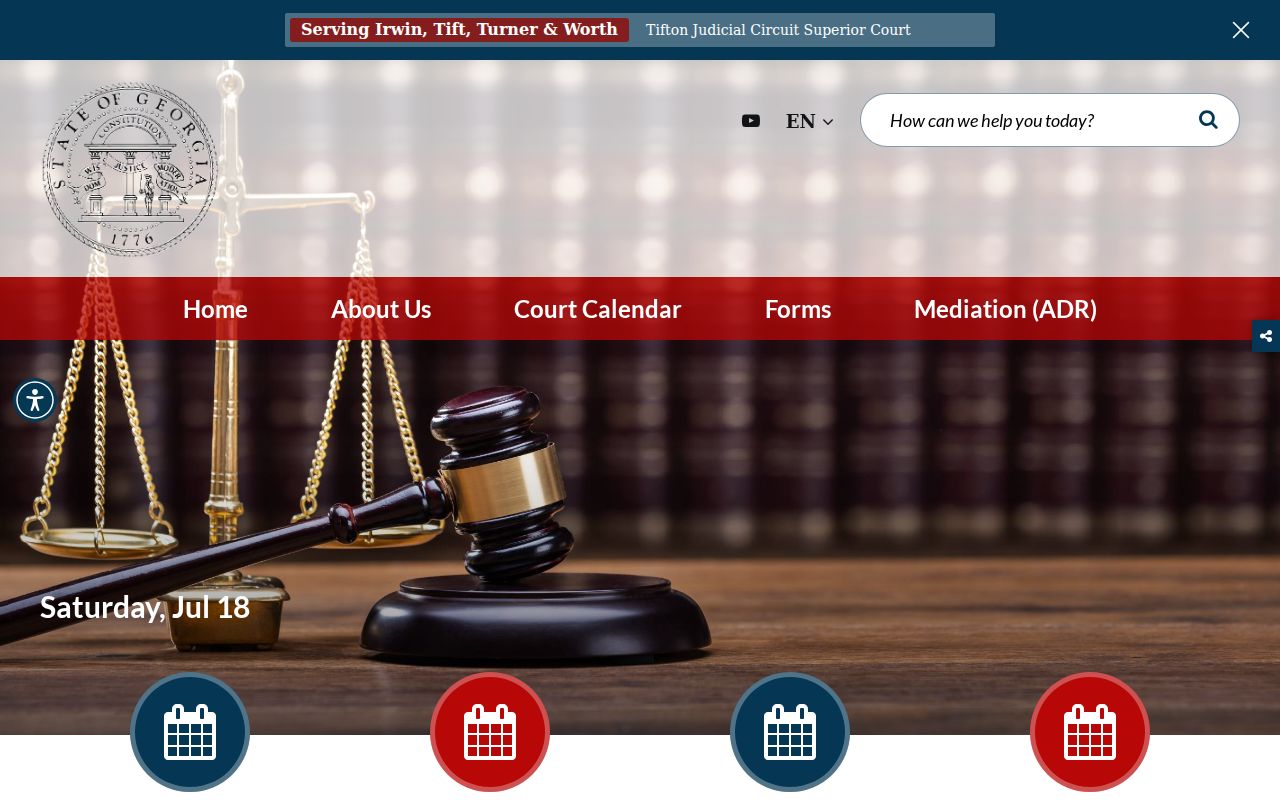
This circuit context prevents a searcher from treating a four-county calendar as a Tift-only docket.
Searching Tift County Case Records
Georgia has no single complete statewide criminal docket search. The Georgia Courts E-Access directory points to participating local systems and lists Tift State Court. Superior Court records still require the Tift clerk's channel. Use a full name, approximate filing or arrest year, and case number when known.
- Decide whether the charge belongs in Superior, State, or Tifton Municipal Court.
- Try the official e-access route for State Court or the municipal payment lookup for a known city citation.
- Give the clerk the full name, likely year, and case or citation number. A birth year may help when the clerk permits it.
- Read the docket by charge. Ask for the accusation or indictment, judgment, disposition, and sentencing order.
- Request counter inspection, copies, or certification when an online result lacks the document image.
For the clerk's official county listing and contact details, consult the Georgia Superior Court Clerks' directory.
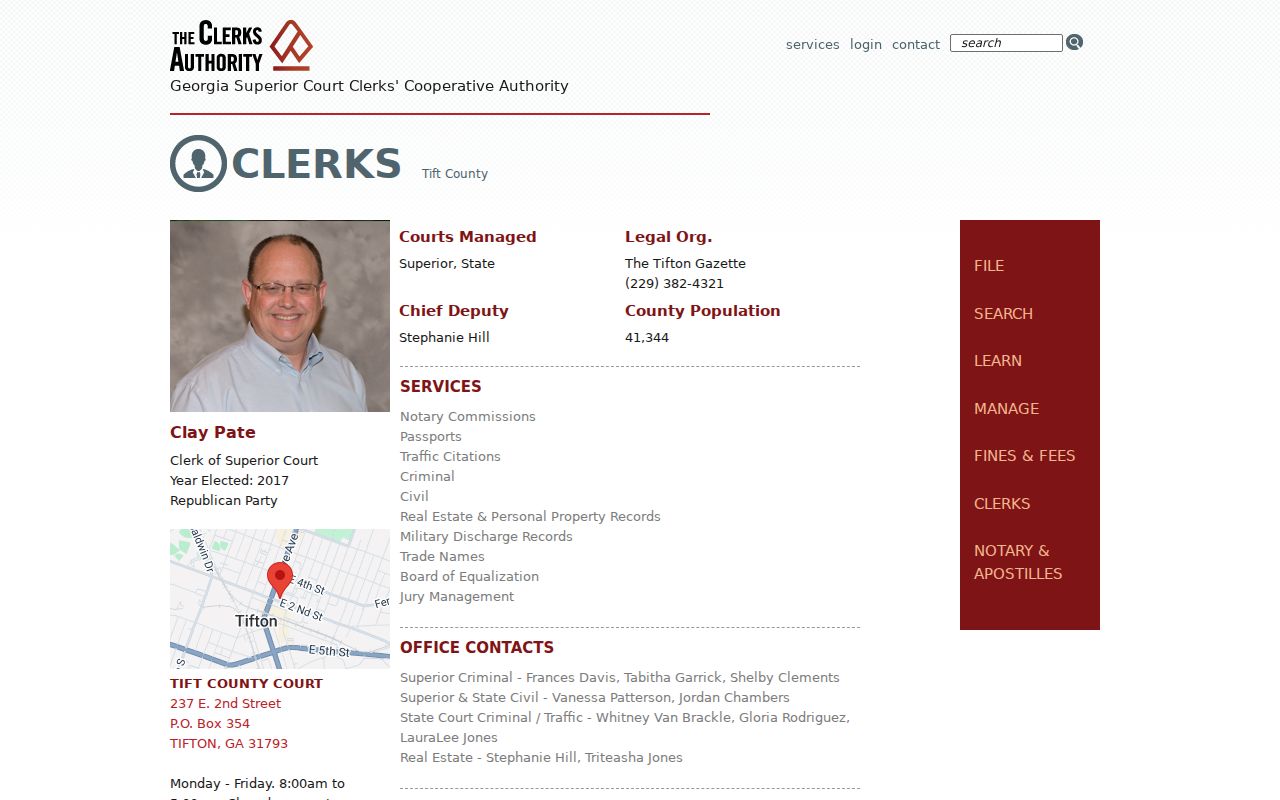
The directory confirms which office holds the county court file when a portal search is incomplete.
Tift Citation Search Is Narrow
The Tift PayYourTix interface is a citation and payment channel, not a full Tift County criminal court case index. It can identify an entry from a last name plus a citation or driver's-license number, or from a case number. A match may display an amount due and payment schedule. It does not promise indictment images, a complete hearing log, charge statutes, counsel fields, or a final disposition.
| Field | Type | Required | Use |
|---|---|---|---|
| State | Dropdown | Yes | Select Georgia |
| Jurisdiction | Dropdown | Yes | Select Tift |
| Case number | Text | Conditional | Use when known |
| Citation number | Text | Conditional | Pair with last name |
| Last name | Text | Yes | Match the ticket |
| Driver license number | Text | Conditional | Required if citation number is blank |
Inside a Tift County Case File
A Tift County criminal case file shows how an allegation became a filed charge and what the court did with each count. The charging paper may be an accusation or a grand-jury indictment. Docket entries track hearings, motions, pleas, trial steps, and orders. Read the final judgment and sentence rather than assuming the first charge remained unchanged.
| Case number and court | Identifies the forum and the clerk's file. |
|---|---|
| Charging document | Shows the formal accusation or indictment and filed statutes. |
| Docket entries | Lists filings, hearings, motions, and orders by date. |
| Plea or trial | Records the method used to resolve each charge. |
| Disposition and judgment | States dismissal, acquittal, conviction, or another outcome. |
| Sentence and conditions | Shows custody, probation, fines, restitution, and court terms when ordered. |
Request Full Tift Court Orders
A docket is an index, not the whole file. For a sound self-review, ask the Tift County clerk for the paper that proves the final result. That may be a signed judgment, dismissal, nolle prosequi, sentencing order, or First Offender order. A certified copy is often the clearest way to resolve a mismatch in another official system.
The clerk-specific copy and certification fees were not published in the reviewed sources. Call 229-386-7816 or 229-386-7810 before ordering. If an online shell exists without images, request counter access rather than concluding that the papers are unavailable. The Superior Court staff source provides another official route to current court contacts.
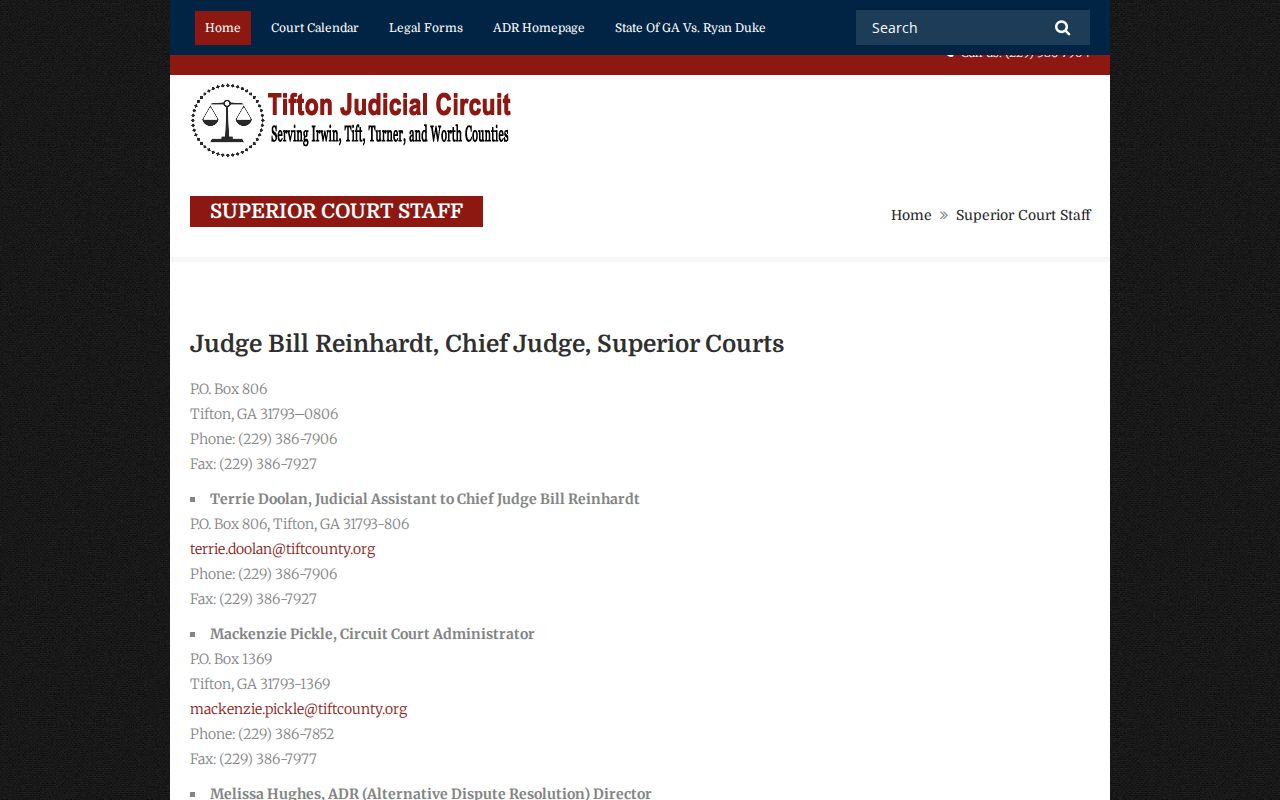
The staff source helps route a question, while the clerk's filed record remains controlling.
How a Criminal Case Moves
A case can begin with an arrest or citation, followed by first appearance and bond. The prosecutor then decides which charge to file. Felonies may proceed by accusation where lawful or by a grand-jury indictment. Arraignment is the hearing where the formal charge is presented and a plea is entered. Motions and discovery come before a plea or trial.
Case flow: Charges Filed › Arraignment › Pretrial › Plea or Trial › Disposition › Sentencing
A municipal case can also produce a transfer record if a jury trial is demanded. Appeals add notices and a record sent to the reviewing court. Dates vary by case, so the Tift docket is the right source for its actual sequence.
Read Tift Dispositions Charge by Charge
One Tift County criminal court case can end in several ways. Do not treat the case caption as the result for every count. Georgia terms have distinct effects, and an arrest charge may differ from the charge the prosecutor files.
- Nolle prosequi
- The prosecutor formally declines to continue that charge, often shown as nolle prossed.
- Dead docket
- Prosecution is postponed without an acquittal or final judgment.
- Acquittal
- A not-guilty result after trial.
- First Offender
- Eligible Georgia treatment that can avoid an adjudication of guilt after successful completion.
- Disposition
- The current or final outcome assigned to a specific charge.
Tift Court Outcomes Reach GCIC
The clerk, prosecutor, or another justice agency reports final Tift County criminal case outcomes to the Georgia Crime Information Center. Tifton's municipal deputy clerk also sends traffic dispositions to the Georgia Department of Driver Services. That reporting step links a local case to state systems, but delay or a missing result can leave a GCIC-derived history incomplete.
If a self-review lacks the final outcome, first obtain the certified Tift County disposition. Then ask the correct clerk to transmit the correction. The court file proves what happened locally; GCIC groups reported fingerprint-linked arrest cycles and outcomes across Georgia. The two records serve different jobs.
Case Record Access & Restrictions
Georgia law generally favors access to public records, but not every part of a Tift County criminal case is open online. Juvenile material, protected victim data, financial account numbers, Social Security numbers, and sealed proceedings can be withheld or redacted. A public docket may show a case shell even when its documents are restricted.
Georgia record restriction limits eligible arrest-history dissemination but does not destroy the record. Court sealing is a related, separate step under O.C.G.A. § 35-3-37(m). When a Tift case does not appear, contact the clerk before assuming it never existed. Older, archived, sealed, or image-only files may require direct inspection.
Tift State Court Defense Channel
Counsel information may appear in a docket, but eligibility for appointed representation belongs with the relevant defense office. Tift State Court publishes an official public defender page. Circuit felony defense is assigned through the Georgia Public Defender Council based on where the alleged offense occurred.
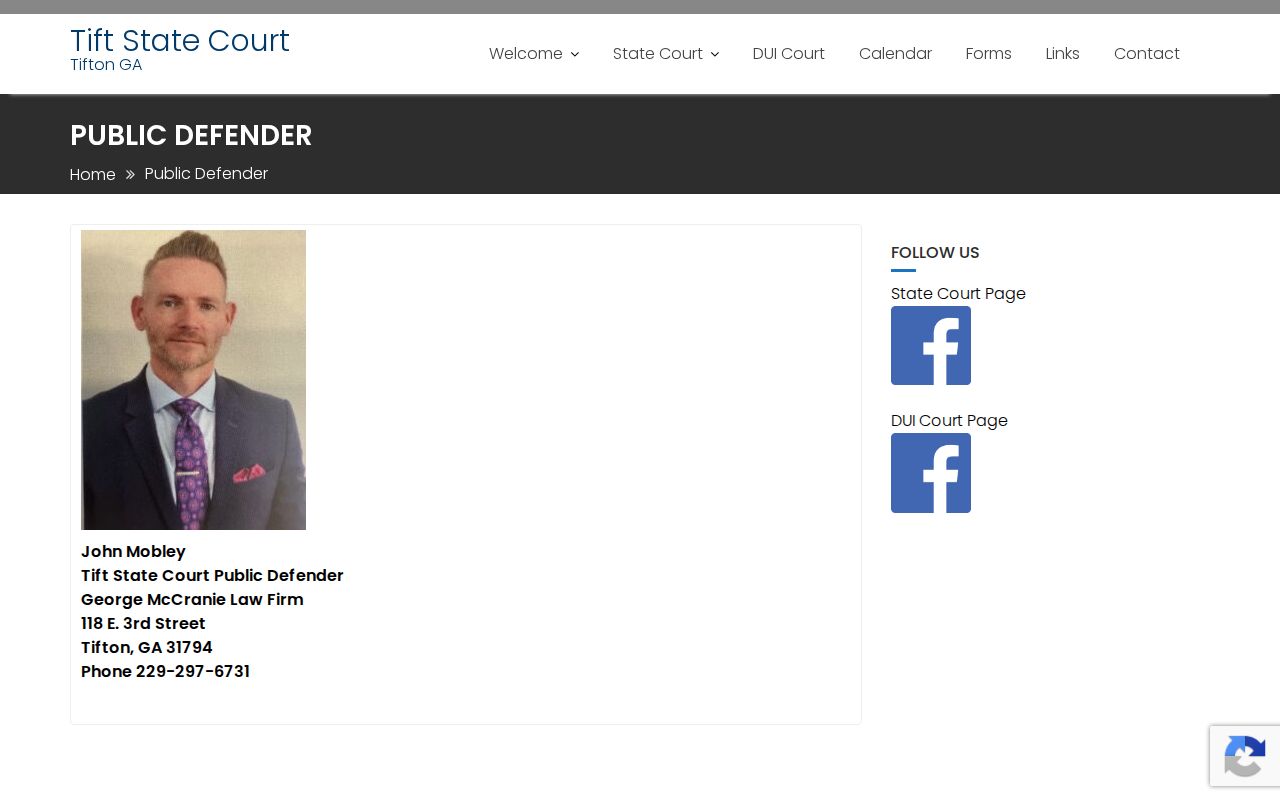
This office channel is distinct from the clerk, which preserves the docket and filed orders rather than deciding representation.